Tuesday, June 22, 2010

An Easy Hive Cutout

I got a call a couple weeks ago from a very nice lady named Kim, who said a newly formed hive over her garage was becoming quite the tourist attraction in her neighborhood. She felt the hive needed to be removed, but was quite adamant about keeping the bees alive in the process. I assured her I could and would. I've started to shy away from cutouts, as I'm finding only about a 50% success rate in terms of the bees staying in their relocated home, but Kim's hive was very accessible and I was so impressed with her concern for the bees, I decided to do this one.

Here's what the hive looked like:


I set up a ladder and a makeshift platform to hold my homemade bee vacuum:


Then, I started vacuuming bees from the comb:


As I removed a majority of bees from each comb, I'd slice them from the stucco using my hive tool. Then I vacuumed off any leftover bees on each comb, and put the comb into a covered bucket.


The activity drew quite a crowd in the neighborhood, so I took the opportunity to give a little bee education to the kids, and let them taste some honey fresh from the comb. Note the amount of capped brood on the comb; I was actually able to show the kids all stages of larva and even some emerging bees.


Once I got all the comb cut away, I had to chase after the holdouts inside the light fixture that was hidden under the hive. I didn't want to miss the queen, and I was worried she might have skedaddled up into a hiding place in the fixture.


It was nearly dark by the time I finished, so I left the vacuum box filled with bees in my truck until morning. Bright and early I rubber-banded most of the comb into frames, loaded the frames into a nuc, and took the nuc and bees over to the Las Flores Community Garden in Thousand Oaks where I have another hive. That's where I opened up the vacuum box and shook them into the nuc. Here's their new home:


Notice the tin pie pans under each leg of the hive stand? I had to put those there because the very first night this poor hive was inundated with ants. So, I put oil (it's an organic garden, so I used corn oil, although at home I often use old motor oil) into the pans, and the ants can't access the hive. All's well; it appears I definitely got the queen, because they're doing fine, bringing in pollen and doing all the regular bee stuff.

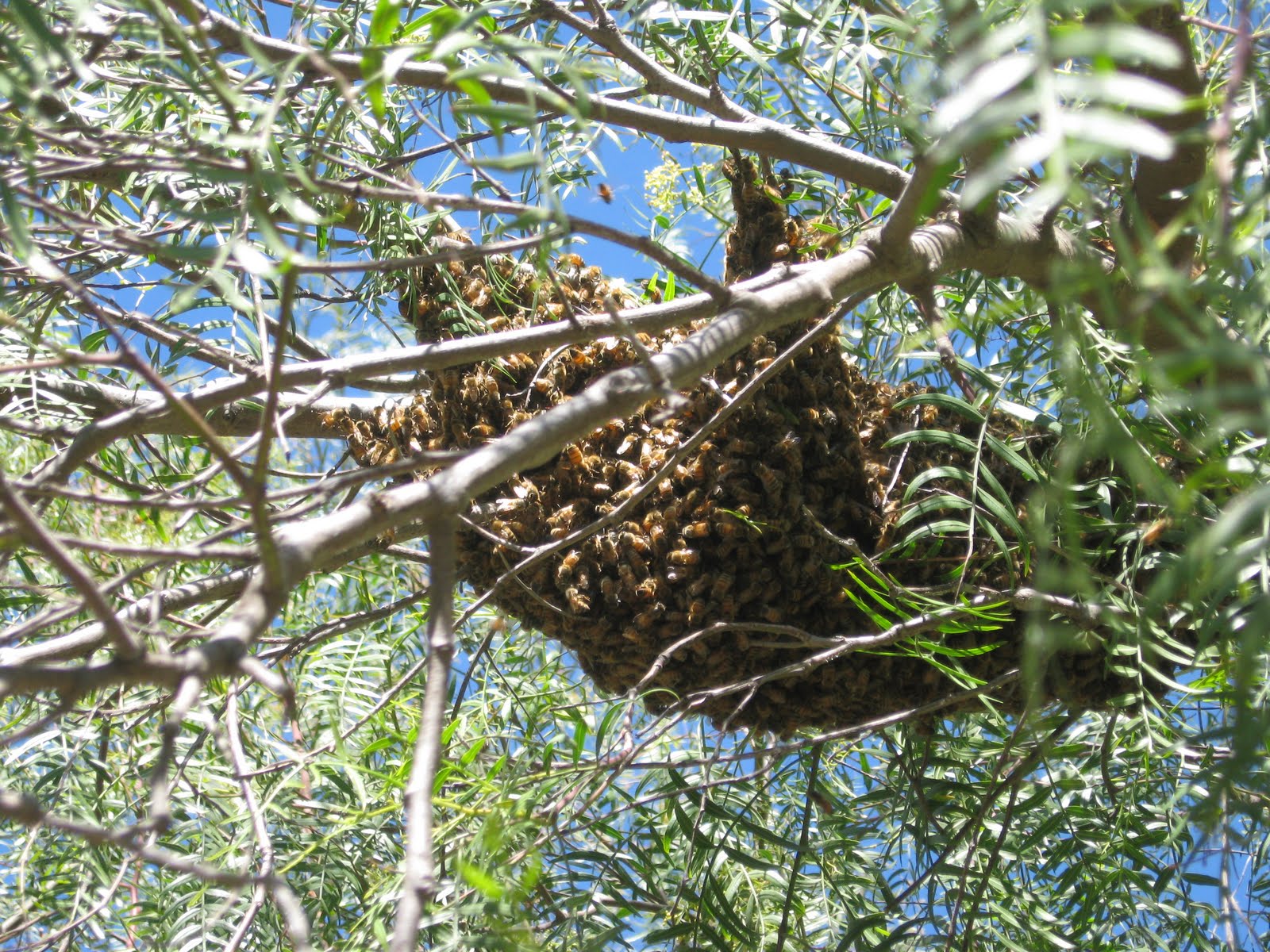
I'll end this post with a look at an absolutely humongous hive that I declined to remove. I would have needed three of the vacuums I have at least, and the comb was gigantic. Weird to see it completely exposed in a tree about 15 feet off the ground, but that's where it was. Here's a look; hope the size translates in these photos...


Monday, May 31, 2010

Bee-zy Come, Bee-zy Go

Haven't posted in awhile because I've been too damn busy answering swarm and hive cutout calls! After giving my name to the Ventura County Fire Dept. as a resource, I've been getting 2-3 calls a day, which of course I have to handle after work. Many times the swarm leaves before I can get there; sometimes the "swarm" is actually an established hive entailing a complicated cutout (which I turn down).

In the meantime, while I've been capturing swarms, a few of the hive cutouts I did do (one as a favor to a neighbor) immediately absconded after I hived them. A lot of work for nothing. In fact, my experience has been that 50% of the hive cutouts aren't happy with their new home, and take off for parts unknown. That little hive I showed below, the one inside the utility closet? Gone. Same with a HUGE hive I cut out of a neighbors garage cabinet. Three hours of work and one torn veil--- down the drain, they left after one day.

On the other hand, I've been lucky enough to catch several swarms. One in a tree in Newbury Park:


Another from a bush in Simi Valley; another from a tree in Moorpark (a weird swarm, it'd been there for five days and seemed very lethargic; jury's out on whether that one will survive); and this one in a Simi Valley rose bush:


I hived all of these into nucs, and the ol' beeyard was starting to get a bit crowded. Plus, I was desperate for a location for the swarm I trapped with a bait hive (a hive body filled with frames, and "baited" with a little lemongrass oil to catch a wandering swarm). I needed to expand that trapped swarm to a larger hive, and I didn't want to do that up in the treehouse where the bait hive was!

Anyway, GREAT NEWS! A neighbor at a nearby ranch was kind enough to offer an excellent location for a an "outyard," so I moved four of the nucs there on Saturday night. I went back Sunday morning to expand the one hive into a deep hive body, and let me tell you, they were PISSED OFF! Sent all my audience (some of the folks from the ranch) scurrying for cover, and I literally had to go for a walk before the bees would stop head-butting my veil. I then had to sneak up on my truck and take off, because I didn't want them finding me again and getting in the truck with me!

I got the hive transferred into a deep, but had to leave the old nuc body there. It still had a generous number of bees, and I just didn't want to shake them into the already boiling-mad hive. So, I left it in front of their new home, and I'll go back next week to retrieve it and see if the hive has settled in. The other three, by the way, did just fine with the transition.

I'll take some pix of the new location for my next post.

Tuesday, May 11, 2010

More Free Bees!

On Saturday I got a call from a neighbor who was having some tree trimming done. Seems midway through one cut the guy sliced into a hive, and bailed out of the tree post-haste (leaving his chainsaw imbedded in the tree).

Anyway, Mike gave me a call for help, and I headed over. It was WAYYY up high, so I climbed up the biggest ladder I've got and sawed through the rest of the trunk while Mike supposedly belayed from below. This shot might give you an idea of the size of this thing:


Actually, I guess it doesn't. Trust me, this was Paul Bunyon territory. The hive entrance is that huge knot on the left. Anyway, when I cut it through the damn thing swung around like a battering ram. I ducked close to the ladder so it missed my head, but it gave me a good whack on the shoulder. Didn't knock me off the ladder, fortunately.

So we lowered it to the ground, I stapled hardware cloth over the openings, and three of us lifted it into my truck. When I got home I just rolled into an empty field next door and pushed the thing out. I pulled the hardware cloth off the openings, and when I last checked the hive is doing fine in their newly mobile home.

And then today...

I got a call from a homeowner with a "swarm" in their utility closet--- you know, the outside closet where the electric meter and the fusebox live. Here are a couple shots:


I grabbed a cardboard box and put it under the cluster, and then used a drywall knife to scrape along the ceiling, the idea being to dislodge the cluster. Only it turns out this wasn't a swarm, but a new hive with three or four combs started! I sliced right through the comb, dropping the entire mess into the box. With no other idea, I simply poured the whole thing, comb and all, into a nuc, and added some frames. I repeated the process several times to continue to remove clustering bees, but I could tell from the fanning activity at the nuc that I'd captured the queen on the first try.

So, I got as many bees as I could and then closed up the nuc, stuck it in my car, and took them home. Here they are on their temporary stand in one of my beeyards:


And finally... one that I let get away. This was a call from the Simi Valley Police Dept regarding a hive that supposedly had bothered some kids. Here's what I found at the end of a cul de sac:


I told them it was not something I wanted to deal with. for one thing, ground-based hives have a better chance of being Africanized, making them more aggressive. For another, I would have needed a city employee to open the manhole cover, and I would have had to bring a generator to power the bee-vac in order to get all the bees.

I also turned down a call to get two hives out of a guy's attic. The idea of laying on my stomach in a hot attic in my beesuit with the (loud) bee-vac going for an hour next to my head was just not very appealing.

But I keep getting one or two calls a day, mostly due to the flier I gave the Ventura County Fire Dept. Tomorrow afternoon I go to Simi Valley again, this time to pick up a wine barrel with a hive inside. The homeowner said I could take the barrel, so this'll be an easy one.

Sunday, May 2, 2010

Caught One of My Own Swarms

So, I was tooling around getting ready to feed the emus at about 10:30 AM on Saturday when I heard an unusual amount of buzzing overhead. Turns out that a swarm must have issued from one of my own hives, and they'd taken up residence in a pepper tree immediately outside the beeyard. Can you spot 'em?


First, a little perspective. Then a close-up:


I grabbed a ladder, a cardboard box, and a nuc (smaller, five-frame hive) plus five frames of new foundation. I keep supplies like this on hand, as Foghorn Leghorn used to say, "For just such an emergency." Anyway, climbed up, held the box under the ball o' bees, and shook. Most of them dropped in a glump down into the box, and I immediately shook them into the nuc. There were a lot of them!


I watched for awhile, and started to slide the top closed. I had to go back up the ladder twice to shake in smaller groups; some of them kept re-congregating at the original swarm location. I kept getting them and shaking them into the nuc, closing the top a little each time...


It was at that point I got really lucky and actually spotted the queen scooting down between the frames! So, I quickly shut them up and took them to their new home... really just about 150 yards uphill at my other beeyard. Here they are:


They immediately started "fanning," a behavior that shows they are marking this as their new home. They stick their abdomens up and release a pheremone from their Nasonov gland (named after the famous beekeeper, Joe Nasonov, who used to mark his territory in much the same way after a plate of refries)and fan it into the air. Other bees fly around orienting themselves visually and with the help of the pheremone, and before you know it, the new hive is up and running! You can spot the fanning behavior here, if you look closely:


It was a busy weekend. On Friday evening I went over to the Community Garden and switched out the nuc for a single "deep" hive, as they were starting to get crowded. I set them next to each other, like this:


I checked the frames as I moved them (briefly, it was really windy) and they were full of capped brood, so another population explosion is on the way in a week or so. Not a lot of capped honey, so they're living hand-to-mouth right now, but they'll catch up once they've got a larger number of foragers. Here they are, all ensconsed in their spacious new digs:

Sunday, April 25, 2010

And the Bees Just Keep On Comin'...

After spending all day Saturday at an Earth/Arbor Day Event--- I had a booth there for my fund-raising company, E-Waste Fundraising--- I got a call from Kim, who heads up the Los Flores Community Garden where I've got a hive (see post below).

A fellow garden member had called her saying there was a swarm of bees that had settled in her compost bin, and could I please come get them? There was an hour or so of daylight left, so I grabbed a nuc box (a small, five-frame hive box; same size as I have in the community garden) and motored over for some free bees!

When I got there, the homeowner had left the lid of the bin on top of her other trash can. Seems she'd opened the compost bin, was a bit surprised by the horde of bees inside, and beat a hasty retreat without replacing the lid. Here's what I found underneath:


If you said, "Hey, that's not a swarm, that's a brand new hive!" you'd be right. You can see the beginnings of comb there in the middle. The homeowner was sure the bees hadn't been there for more than a day or two, so they were working fast. Bees love compost bins, presumably because they're dark and warm and well-protected from the weather.

Anyway, I treated them like a regular swarm. Just picked up the lid and shook it over the nuc, with several frames removed. I waited a bit for all to settle, and then put some more frames in. I scooped up by hand any globs of congregating bees that had missed the box, stuck the top on (I had the entrance blocked with hardware cloth) and went home.

The whole operation took about 15 minutes, most of which was spent waiting to give all the bees a chance to reorient from the trash can lid. To help that out, I actually leaned the trash can down onto the open hive box, so they could sense the queen inside and would walk in on their own.

I brought 'em home, left them for the night in the back of the truck, and put them on a hive stand in the AM. I checked a couple times today; they were orienting themselves and doing very well.

Sunday, April 11, 2010

Cupola Cutout

Well, in spite of the imminent threat of rain I headed over to Newbury Park today around 4:30PM to remove a hive that had ensconced itself in a cupola (an architectural flourish to add character to the roofline; in this case basically a little triangular projection above a window).

The homeowner, a former fire chief and a current carpenter, was a huge help. He built a platform for me to stand on, and had already removed all the nails from the sheeting on the front of the cupola. Plus, he had an extension ladder in place. So, all I needed was:

- The bee vacuum (see my log removal video to view this in action)
- Hive tool (for cutting away comb)
- Smoker and additional smoker fuel
- Bucket with a cover (for the comb)
- Veil and jacket
- Thick rubber gloves
- Flashlight

I pulled away the sheeting, and here's what I saw:


Here's a closer view. Doesn't look like too big a hive from here, does it?


Suffice to say there's more than meets the eye. The hive was six combs deep, with a good-sized population hiding away from me on the opposite side of each comb. I started by smoking them thoroughly, although I have to say that this was an extremely docile hive throughout the procedure, even when my smoker petered out due to user neglect :-)

Anyway, after smoking I started vacuuming, and as I cleaned each comb up I'd reach in, cut it free, and carefully transfer it into a bucket. Each comb had a good mix of capped and open brood of various ages. You can see the multi-colored pollen on that foremost comb in the photo above; there was also a decent amount of stored honey--- all in all, a very healthy hive.

When I finished, here's how it looked:


I hurried home with a boxful of bees and a bucket full of comb, trying to beat the oncoming darkness and rain to get these gals hived. I strapped their brood comb into frames, like this:


I added some regular frames of foundation, and got them hived just as the rains started. As I write this it's really coming down; wind is howling, and absolutely pouring. I know there were some stragglers when I hived them; I'm sure they got caught by the rain and probably didn't make it into the hive. I scooped as many as I could by hand and put them in, and I made sure I didn't see the queen wandering around anywhere before I closed them up. Hopefully she's in there; you never can tell with a cutout, because there are inevitably a number of "leftover" bees and plenty of casualties. I never actually saw her, but I was careful to vacuum any "glumps" of bees in particular, thinking that they may be crowding around the queen. Time will tell.

Saturday, April 10, 2010

Winter's Honey Extraction and More

First, I'll follow up on the hive that I placed at the Community Garden (see below post). It's doing very well. I opened it up and took a look; a solid two frames of bees, and they immediately started drawing out the foundation-only frames I'd put in there. They're going to do just fine. I'll give 'em a couple more weeks, and then I'll move them into a full-size 10-frame hive.

Now, on to the subject of this post: honey extraction. One of the best things about beekeeping in the SoCal climate is that we actually can get an "end-of-winter" harvest. We had some nice rains in Feb., and the combination of Ceonothus, Eucalyptus, various Rosemary strains, and Lavenders led to some excellent build-ups in a couple of my hives.

Here's a shot of one of the frames from a 10-frame super; every frame on the super looked roughly like this. You're looking at capped honey, and along the sides some uncapped but perfectly extractable honey.


Here's another frame, this time immediately after I uncapped. I just use a serrated knife, which I dip frequently into very hot water, and slide it along the bottom bar of the frame to slice as thin a layer of cappings wax as I can.


When I pulled the frames from the hives, I use Fisher Bee-Quick, a natural repellant which I spray on a special "fume board." Here's the video I did last year, showing how that's done:


Which all looks and sounds great in theory. Unfortunately, sometimes you run across supers that have some brood in the frames, and the bees are very reluctant to leave. That's what happened in the case of one of the hives, so I had to use a "bee brush" (a soft paintbrush works well too) to brush bees off the honey frames prior to putting them into a tupperware container. You don't want to leave the honey frames out in the open, or you start a robbing frenzy when the other bees in the yard get a whiff of the honey.

All that brushing makes them mad, and I learned something: if you wash leather glvoes enough, they eventually lose that sting-proof quality that made them so desireable in the beginning. I got nailed THROUGH the glove; which meant the poison sac was actually outside the glove, and the doggone stinger was puncturing my hand again and again as I moved around inside the glove. I had my hands full, so couldn't remove it.

So here's my regular, unstung hand:


And here's the other one, about twelve hours after I finished pulling the frames:


Finally... I got a call today from a guy that has a beehive in a kind of soffit under some gables--- they're entering through an opening in the roof. He's going to build be a platform I can stand on while I pull this hive out tomorrow. I'll post some pix--- wish me luck! :-)

PS- By the way, the honey is friggin' delicious! I extracted a total of 16 frames from two hives, (ten from the hive I did a split on just a few weeks ago!) and I'll weigh all that to see what it comes to, pound-wise. The purple sage flow is starting, so I wanted to clear all the supers in preparation.